The Results Are In: What 240+ Business Professionals Revealed About Decision-Making, Risk Appetite, and Career Priorities

 23rd July 2025
Insights and analysis from Chris Preston, CEO, Zeren & Renoir
The Mobility Mindset: Five Insights into Today’s Candidate Market Dynamics
Understanding what influences the decision-making process for candidates has never been more important. As competition for top talent intensifies, employers must adapt to how individuals are now approaching career decisions. To explore this shift, we conducted a five-part survey series focused on candidate mobility and market confidence, gathering input from more than 240 professionals.
The results point to a candidate landscape defined by high awareness, shifting priorities, and a clear demand for more responsive and flexible hiring practices.
The Always-On Talent Market
The idea of a dormant candidate pool is increasingly outdated. According to our research, 46% of professionals say they are actively exploring new roles. Another 38% remain open to standout opportunities, even if they are not applying directly. Only 17% describe themselves as casually curious.
This suggests a market where most professionals are consistently tuned in to what’s out there. The traditional split between “active” and “passive” candidates no longer reflects how people think about opportunity. When 84% of professionals are open to change, the risks of losing talent, or missing it altogether, are far higher than many companies might assume.

Flexibility Comes First
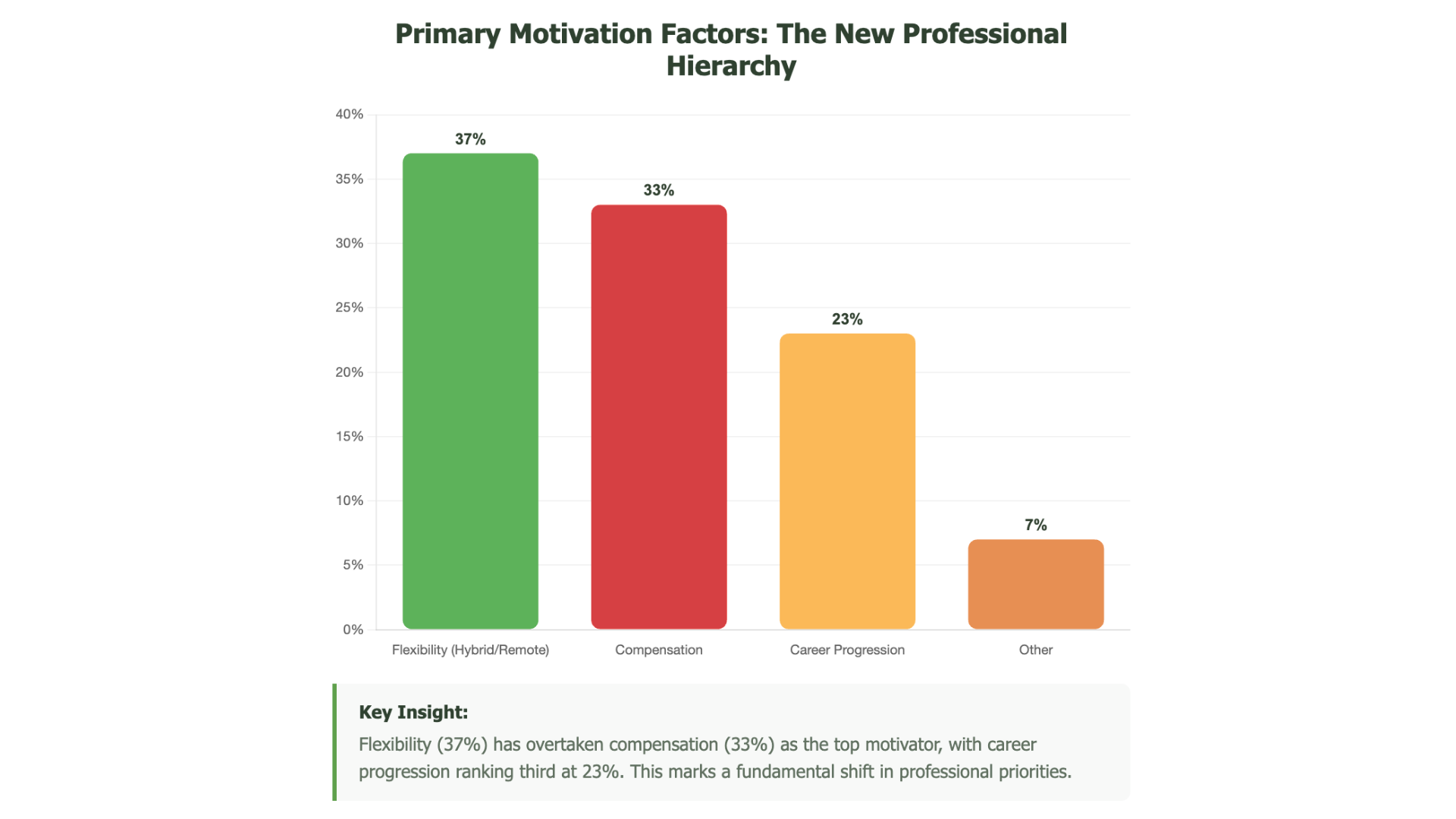
When asked what drives career moves today, flexibility came out on top. Hybrid and remote working arrangements were cited by 37% of professionals as their primary motivator, edging out compensation at 33%. Career progression ranked third at 23%.
This marks a clear shift in how value is perceived. While salary remains a key motivator, flexibility is no longer seen as a perk, it has become a baseline expectation. For many professionals, the ability to control how and where they work is now fundamental.
Interestingly, the lower ranking of progression suggests that traditional vertical moves may no longer be the most attractive path. Lifestyle preferences and financial considerations appear to carry more weight than a new title. This presents an opportunity, and a challenge, for employers looking to keep talent engaged without relying solely on promotion structures.
A Clear Appetite for Risk
Conventional wisdom suggests that in times of uncertainty, professionals become more cautious. Our data challenges that assumption. When asked about high-growth or high-risk roles, including early-stage ventures or turnaround environments, 58% said they would actively pursue them. A further 36% said they would consider such roles, depending on the details.
Only 6% expressed a preference for stability or viewed risk as off-limits. Far from avoiding volatility, many professionals are actively drawn to it as long as the potential rewards are clear.
For hiring managers, this is an opportunity to rethink how ambitious roles are positioned. While not everyone is built for transformation, many are motivated by the promise of growth, even when it comes with pressure. Presenting a challenge in a clear, compelling way can open doors to a broader and more driven talent pool.
The 48-Hour Decision Window
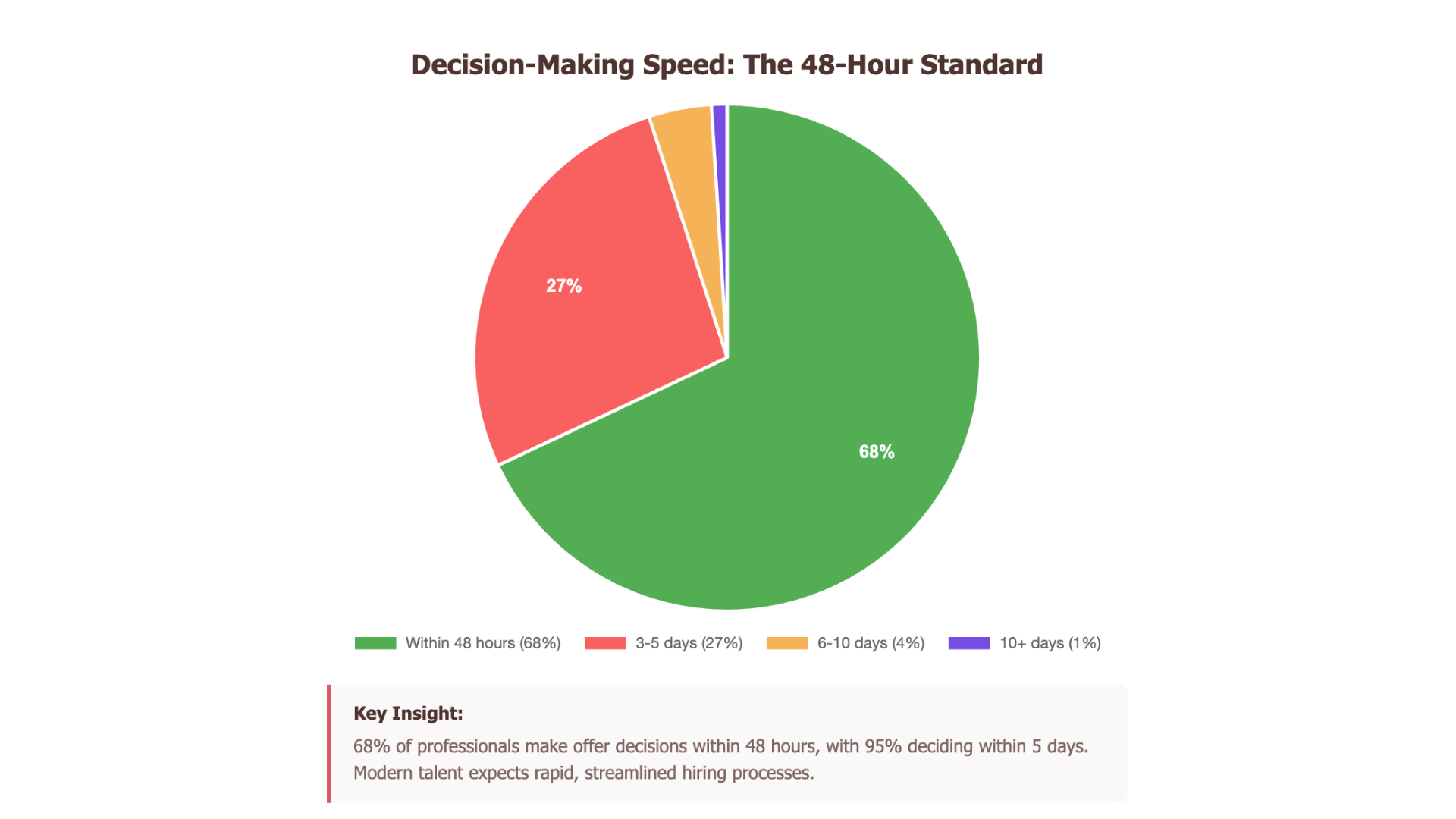
One of the most significant shifts revealed in the research is the speed at which offer decisions are made. 68% of professionals said they would accept or decline an offer within 48 hours, while another 27% would take no more than three to five days. That means 95% of decisions are being made in under a week.
This pace reflects a broader market trend. Professionals appear more confident in evaluating roles and aligning them with their goals, possibly due to greater clarity on their priorities and increased access to information. It also indicates that top candidates may be weighing multiple offers and expect employers to move quickly.
For organisations, slow hiring processes are becoming a competitive liability. Extended approval chains, multiple rounds of internal consensus, and drawn-out deliberations are often incompatible with how fast professionals are prepared to act.
The Kitchen Table Factor
Career decisions are rarely made alone. Our data shows that 61% of professionals involve family members in the decision to accept a role. Only 29% said they decide independently. Mentors and recruiters each accounted for just 5% of influence.
This points to a deeply personal element of career choice that is often overlooked. For many, accepting a new role is as much a family decision as it is a professional one. It involves questions about lifestyle, travel, location, and work-life fit and these questions are not confined to the candidate.
For hiring leaders, this means shifting how opportunities are presented. It’s not just about the job title or salary. It’s about how the role fits into the bigger picture of a candidate’s life. Framing offers in this way builds trust and improves engagement. It also reflects the reality that career decisions today are made around the kitchen table, not just across the boardroom one.
Implications for Leadership
The data paints a clear picture of a market in flux. Loyalty cannot be assumed, nor can professional priorities be predicted based solely on compensation or title. Professionals are more selective, more aware, and more confident in acting on what matters to them.
Flexibility now sits at the core of the value proposition. This goes far beyond location. It is about trust, autonomy, and the freedom to do meaningful work in a way that fits the individual. Employers that meet this standard will not only attract talent but also keep it.
The strong interest in high-growth, high-stakes roles suggests that professionals are not looking for easy rides. They are willing to take on risk when the opportunity is clear and the path forward is well defined. Leaders should feel encouraged to present bold roles, provided the expectations and rewards are aligned.
The influence of family adds an important dimension. To be successful, hiring strategies must reach beyond the CV and acknowledge the role of partners, children, and life outside of work. This is not a distraction from the process. It is part of what makes the opportunity real.
The Path Forward
The rules of engagement have changed. Today’s professionals are clear about what they want: flexibility, meaningful challenge, competitive pay, and roles that make sense in the context of their wider lives. These are not preferences. They are expectations.
In a market where talent is always listening, always weighing options, standing still is not neutral. It is a step backwards. Employers that rely on outdated assumptions about loyalty, process, or hierarchy will find themselves outpaced by those who adapt with speed and intent.
To succeed, organisations must think beyond job specs and salary bands. They must design opportunities that speak to ambition and alignment, not just skill fit. The businesses that recognise this shift, and act on it, will be the ones who continue to attract and retain the people driving growth, transformation, and long-term value.
Insights from Chris Preston, CEO Zeren & Renoir. Chris leads the global teams at Zeren and Renoir, bringing over 20 years of experience building teams, brands, and businesses. He has partnered with clients around the world to deliver permanent, interim, and consulting solutions.
Contact Chris directly to discuss the findings from our latest survey or to explore how Zeren can support your leadership hiring needs, from key individual hires to full team builds.
Want to know what top performers are earning in 2025?
Get access to our latest Zeren Remuneration Report, full of real-world data on compensation across Sales, Marketing, Product, Engineering, Data, and more.
Whether you’re scaling teams or exploring your next opportunity, having up-to-date insights on salaries, bonuses, and equity is essential in today’s market.
This report brings together verified data from hundreds of placements to give you a clear, practical view of current compensation trends across tech and high-growth businesses.
Here’s what you’ll find inside:
- Current salary benchmarks by role and seniority
- Bonus and variable pay trends across functions
- Equity norms by stage and leadership level
- Data pulled from real offers, not guesswork
Who’s this for?
- Founders & Leadership Teams – Set competitive, compelling offers
- People & Talent Leaders – Shape your comp strategy with confidence
- Investors – Gain visibility into hiring and cost-of-talent benchmarks
- Candidates – Understand your market value and how you stack up
📥 Download your complimentary copy of the report.
Fill in the download form and get immediate access.