AI Is Not the Risk — Your Leadership Team Is

 5th May 2026
Somewhere in a European boardroom right now, a leadership team is discussing AI. They have a slide, a budget, and a plan for it. What they probably do not have is a single leader who has fundamentally changed how they operate because of it.
The leadership teams running many European venture-backed companies right now likely lack the tangible track record for what the next three years will demand of them. Not because they are not talented, not because they have not worked hard, but because the job has fundamentally changed.
We have spent the last two years talking about AI as though awareness is the same as capability. Boards ask whether their leadership teams are on top of AI. And then everyone returns to running businesses that look structurally identical to how they looked in 2022, with a ChatGPT licence and a slide about AI strategy in the board deck.
That is not transformation.
“The question is not whether your leadership team knows what AI is. It is whether they have rebuilt how they work because of it. Most have not and most boards are not asking.”
The Talent Gap
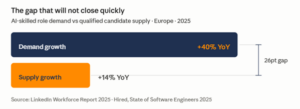
The talent decision is the investment decision. We simply have not built the discipline to treat it that way. In an era where AI is restructuring every function, the cost of that gap is compounding in ways that most boards will not see until it is deeply expensive to address.
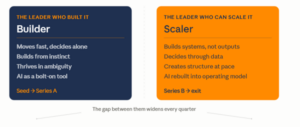
Let’s go through a few examples together. The VP Sales who built their career on outbound volume is operating in a market where AI has restructured the buyer journey beyond recognition. The CFO who has historically added value by controlling access to financial data is operating in an organisation where AI gives leadership teams direct access to the same numbers. The Head of Product running a roadmap process designed for a world where shipping velocity was the primary constraint is now working in one where intelligence is, and the process has not caught up. These are real profiles, in real companies, right now, and the gap between what those roles require and what those leaders are currently delivering is widening every quarter.
The founder conversation nobody wants to start
Founders are not without responsibility here either.
There is a particular kind of loyalty in early-stage companies that is one of the most powerful things about them and one of the most quietly destructive when left unexamined. The people who believed in the mission before it was credible, who worked through the uncertainty, who built something from nothing, those relationships carry real weight and they should. Unfortunately, loyalty and honesty are in conflict, and allowing a leader to remain in a role they are no longer fully fit for is not loyalty. It is avoidance dressed up as kindness, and the cost of that avoidance is borne not just by the company but by the leader themselves, who deserves an honest conversation far more than a comfortable silence.
The founders building the strongest organisations right now are having the hardest conversations earliest. They are not waiting for underperformance to become undeniable before they act. They are asking, continuously, honestly, and with genuine curiosity, whether the people around them are evolving as fast as the environment they are operating in. That discipline is not ruthlessness. It is the most important thing a founder can do for the people they lead.
“The most expensive leadership failure is not the one that ends in a resignation. It is the one that never gets named, compounding quietly for twelve months while everyone in the room pretends not to notice.”
What needs to change and why it cannot wait
Stop assessing leaders on what they have built and start assessing them on how they have evolved. The CV carrying the right logos and the right headcount numbers is a lagging indicator in a market being restructured in real time. The forward-thinking question could be how this leader has rebuilt their operating model in response to AI, and what their team’s output looks like as a result, is more predictive of success over the next three years than anything a reference check will surface.
Build honest capability conversations into your operating rhythm. Not performance management, not annual reviews, but genuine and ongoing dialogue about where leaders are stretching and where the role is moving beyond them. The leaders thriving in this environment are not the ones who have all the answers. They are the ones honest enough to name the questions they cannot yet answer.
And where the gap is real, address it with support, with interim capability, with structural change, if necessary, but address it with urgency. Because a gap that goes unnamed does not stay still.
The European venture ecosystem is producing world-class companies while quietly accumulating a leadership debt that will come due in missed opportunities, in value left unrealised, and in the compounding cost of organisations that scaled their ambition faster than their leadership could follow. That debt is already accumulating. The only question is whether you choose to confront it now—or pay for it later, at a far higher cost.
Additional Thoughts
- Why is leadership the biggest AI risk for PE-backed companies?
Most PE-backed leadership teams have a ChatGPT licence and an AI strategy slide. What they lack is a single leader who has rebuilt how they work because of it. The gap between AI ambition and operational capability is the defining talent risk of the current cycle. - How should a board assess a leadership team’s AI capability?
Stop reviewing CVs and start assessing operating models. The forward question is how a leader has changed their team’s output as a result of AI — not which companies they have worked at. Reference checks will not surface this. Structured capability interviews will. - What is leadership debt and why does it matter for PE investors?
Leadership debt is the gap between what roles now require and what incumbents currently deliver. In AI-accelerated markets this gap compounds fast — in missed product velocity, lost commercial efficiency, and value left unrealised at exit. It is already accumulating across the European VC ecosystem. - When should a founder replace a loyal but underskilled leader?
Before underperformance becomes undeniable. The founders building the strongest organisations are having the hardest conversations earliest — asking continuously whether the people around them are evolving as fast as the environment. Comfortable silence is not loyalty. It is avoidance — and the cost is borne by the company and the leader.
Chris Preston is CEO of ZEREN, a leadership, team hiring and interim leadership executive search firm working with venture-backed businesses and investors across Europe. ZEREN and EUVC have produced The European VC Leadership Playbook — a practical guide to building the leadership teams that scale, from seed to exit. Read it here.